Play Okey Online: Rules, Hands, and Winning Strategy
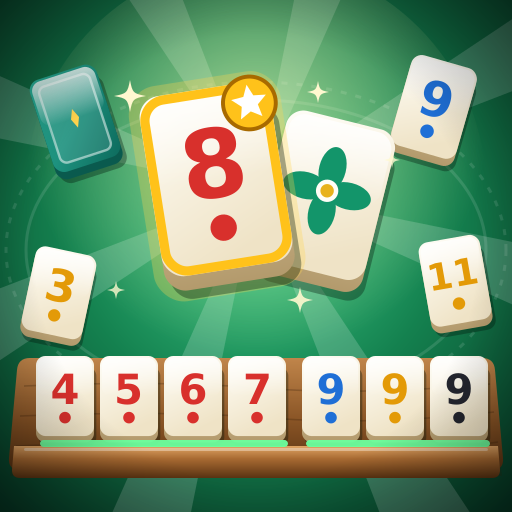 Play Okey freeOpens in your browser, no download, no sign-upPlay
Okey can also be played online against other people, not only against the computer.
Okey is a traditional four-player tile game played with runs and groups on a two-tier rack. In this free browser version, you can play Okey online immediately without installing software or creating an account. Sitting at a polished wooden rack, your goal is to draw, meld, and discard until your fourteen active tiles form valid sets, leaving a single tile to close out the hand.
Whether you are familiar with classic tile rummy or discovering the game for the first time, this guide covers everything you need. You will find clear instructions on tile setup, wild okey mechanics, scoring rules, rack management, and how our single-player league tables test your tactical instincts against computer opponents.
What Okey Is: Origins and Heritage
Okey is a four-player tile game from Turkey that shares conceptual roots with Rummy and Rummikub while following its own distinct rules. It is traditionally played at four-player tables alongside classic board games like Backgammon and card games like Batak and Pişti.
What separates Okey from traditional card rummy is its tactile pacing, hidden hands, and rotating wildcard system. Instead of playing cards, four players manage numbered tiles resting on personal two-tier wooden racks. The table stays clean because hands remain concealed until one player declares a finished layout, creating suspense on every single discard.
How to Play Okey Step by Step
Okey uses 106 tiles numbered 1 to 13 across four colours (red, black, blue, and yellow), with two identical copies of each number, plus two unnumbered false jokers. Here is how a round proceeds from setup to declaration:
- Deal the tiles: the starting player receives 15 tiles, while the other three players receive 14 tiles each on their racks.
- Reveal the indicator tile from the central stock pile. The okey tile for the round (marked with a gold star) is the same colour and one number higher, while false jokers stand in for it.
- Check for the indicator bonus on your very first turn; if you hold the matching twin of the indicator, tap Show to dock 1 point from every other player.
- The starting player discards their 15th tile directly to the right without drawing, passing the turn counterclockwise to the next player.
- On subsequent turns, draw an unseen tile from the central pile or pick up the tile discarded by the player to your left.
- Organize your rack into valid melds: runs of three or more consecutive numbers in one colour (12-13-1 is legal), groups of three or four identical numbers in different colours, or seven pairs.
- Finish the round when 14 tiles form complete sets or seven pairs, tapping Finish with your remaining 15th tile to claim the win.
Objective, Scoring, and Winning the Match
Unlike card games where players accumulate positive scores, Okey is played as a point-deduction competition. Matches begin with each player holding an equal pool of points, commonly set at 8, 12, or 20 points. When an opponent finishes a hand, points are deducted from all rivals. Once any player drops to zero points, the match ends, and the participant with the highest remaining score wins.
A standard finish with complete runs and groups deducts 2 points from every rival. Winning with seven pairs doubles the penalty to 4 points per rival. Discarding the wild okey tile to finish also inflicts a 4-point penalty on all opponents. If an ambitious player completes seven pairs and discards the okey tile as their winning discard, rivals lose 8 points each. If the central pile runs out before anyone finishes, the round ends in a tie and nobody loses points.
Essential Okey Strategy and Rack Management
Consistent success requires balancing your own meld requirements against what you give away to your rivals. Apply these practical tips to improve your win rate:
- Keep the wild okey tile for the hardest gap in your hand, or reserve it as your final discard to double the point penalty for rivals.
- Watch what your right neighbour picks up, and avoid throwing tiles in colours or numbers that complete their runs or groups.
- If you hold a twin of the indicator tile, tap Show on your first turn so every other player loses 1 point.
- Go for seven pairs early if your rack has many matching tiles, since pair finishes cost rivals 4 points instead of 2.
- Remember that false jokers act as exact stand-ins for whichever normal tile was promoted to the wild okey for that round.
- Bear in mind that 12-13-1 is a valid sequence, but runs cannot wrap further; sequences like 13-1-2 are not allowed.
- Discard safe tiles that have already appeared multiple times on the board when you need to avoid feeding the next player.
Common Mistakes Beginners Make
Keep an eye out for these frequent tactical errors when arranging your rack:
- Discarding duplicate tiles too early before evaluating whether a seven-pairs hand is feasible with your opening distribution.
- Feeding the opponent to your right by casually pitching tiles that bridge the discard they just picked up.
- Trying to create impossible wrapping runs like 13-1-2 or 1-2-13, which are invalid under official Okey rules.
- Confusing the gold-star wild okey tile with the false jokers, which simply represent the number displaced by the real okey.
- Holding onto an unmelded okey wildcard without a clear plan, risking defeat if an opponent finishes quickly.
Rule Variations and How Okey Compares to Rummy
While Okey belongs to the broad rummy family, its playing style differs fundamentally from Western card rummy or Rummikub. In those games, melds are played openly to the middle of the table where rivals can build upon or rearrange them. In Okey, melds remain entirely private on your wooden rack until someone declares a complete hand, creating an intense game of deduction and defensive discarding.
Across the region, players also enjoy variations such as 101 Okey, where players meld openly once their sets reach a value of 101 points. In our browser version, you play classic Okey with indicator bonuses, seven-pair hands, and point matches starting at 8, 12, or 20 points across Easy, Normal, and Hard computer difficulties.
Playing Okey on Popyca
Our version brings the game to your screen on a polished wooden rack, featuring three computer rivals with their own distinct characters on Easy, Normal, and Hard difficulty. The game runs directly in any modern desktop or mobile browser without downloads, installation, or account registration.
Tile controls are straightforward. Tap to draw from the pile or left discard, or to pick a tile; drag to rearrange your rack or drop a tile on the right to discard; and double-tap to discard quickly. When 14 tiles form complete sets or seven pairs, tap Finish with your 15th tile. Desktop players can use Space or Enter to draw, discard, or finish, R to sort runs, D to sort pairs, and Esc or P to pause. You can climb through an eight-table league from the Garden Café to the Grand Table, earning coins and unlocking new racks and tables along the way.
Frequently asked questions
How does scoring work in Okey?
Everyone starts with the same points (8, 12 or 20). When a player finishes, every rival loses 2 points, 4 for seven pairs or a finish with an okey tile, and 8 for both. When someone reaches 0, the player with the most points wins. If the pile runs out, nobody loses points.
How do you determine the wild okey tile?
The face-up indicator tile sets the okey: the same colour and one number higher (with 13 wrapping to 1). Tiles marked with a gold star act as wildcards for that round, while the two false jokers stand in for the promoted tile.
Can I play Okey online for free on my phone?
Yes, you can play Okey directly in your mobile browser on any smartphone or tablet. The game is free, requires no download or account, and features intuitive tap and drag controls for your tiles.
What is the difference between Okey and traditional Rummy?
In traditional rummy and tile games, players place melds openly on the table and can manipulate each other's sets. In Okey, all melds remain completely hidden on your two-tier rack until a player finishes their entire hand, emphasizing memory, discard tracking, and sudden declarations.
Can a run wrap around 13 to 1 in Okey?
Yes, but only in the combination 12-13-1 in a single colour. The sequence cannot loop further past the number 1, meaning that runs such as 13-1-2 or 1-2-13 are illegal according to standard Okey rules.
How do I move up the league?
There are eight tables, from Garden Café to Grand Table. Finish first for 3 stars or second for 2; a top-two finish opens the next table. Coins buy new racks and tables in the shop.